



Operator expectations are becoming more specific as suppliers expand into new regulated markets, with greater focus on localization, performance, and the kind of support providers can offer beyond the initial integration.
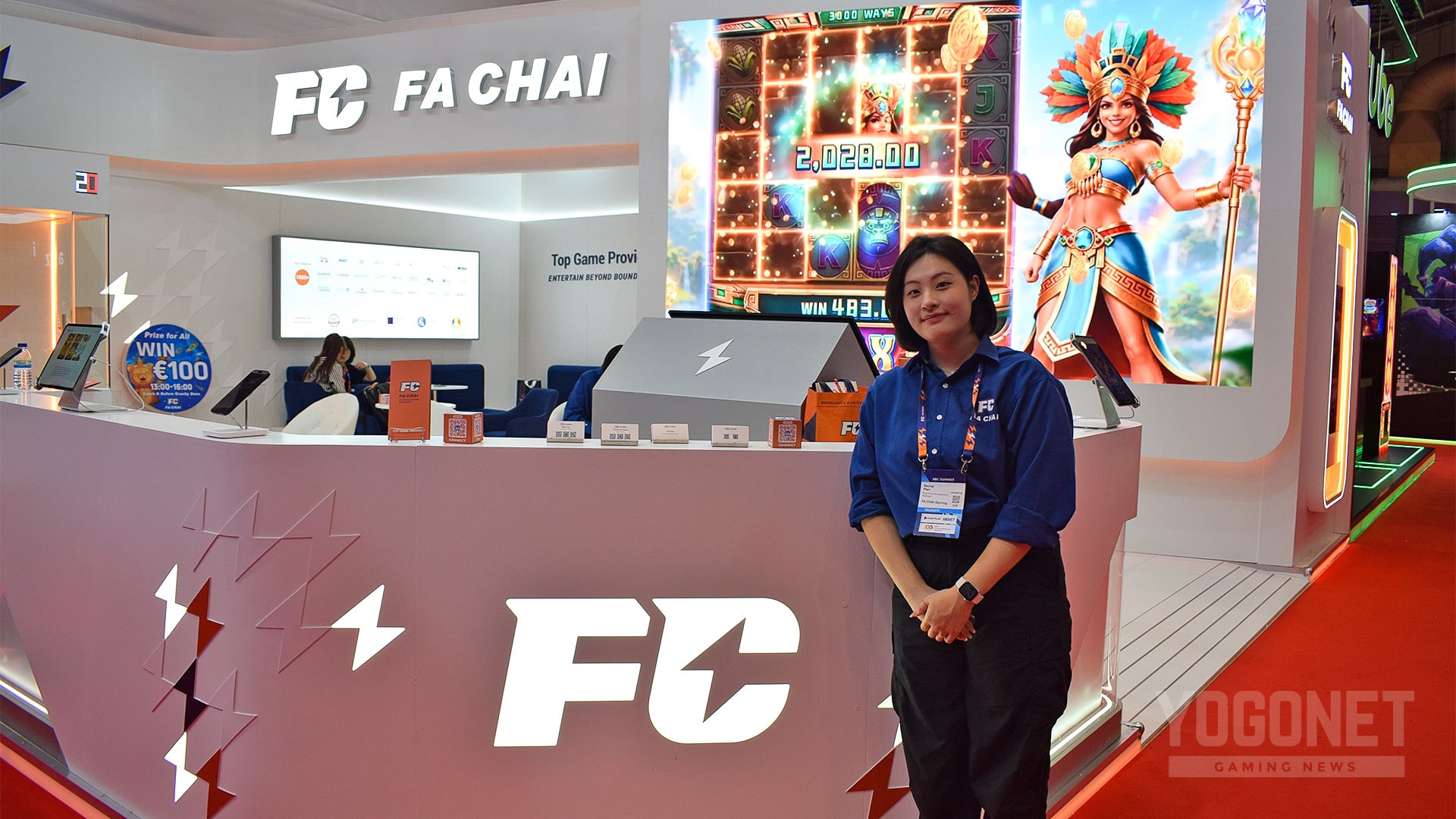
Speaking with Yogonet during SBC Summit, Rachel Pien, Business Development Manager for LatAm and Europe at FA CHAI Gaming, discussed how those expectations are shaping its conversations with operators, the importance of adapting games to local player preferences, and the role experimentation continues to play in its development strategy.
The company also showcased Power of Vikings for the first time, while discussing the performance of its recent releases, its expansion beyond Asia and the thinking behind interactive activations such as its Space ATM Challenge.
What stood out to you during SBC, and what were operators most interested in discussing?
It was incredibly positive for us. We had conversations with partners from very different markets, and what stood out was how specific operators are becoming about what they are looking for.
It is no longer simply about adding more games to the portfolio. They want to understand what performs in their particular market, what we can bring that is different for their players, and how a provider like us can support them beyond the integration.
That has been very encouraging for us because it is closely aligned with how we have been developing. We believe there is no single formula that works everywhere, so a lot of our conversations naturally moved toward local preferences and how we can work more closely with operators on content and promotions.
What also surprised me was the level of interest in exploring different types of content. Operators are very open to discussing new mechanics and experiences rather than simply looking for something that has already been proven successful elsewhere.
For example, we are very strong in Asian markets, but operators are not simply asking us to replicate what already works there. That creates a lot of opportunity for us as a studio and game provider because experimentation has always been an important part of how we develop our products.
Power of Vikings was showcased at SBC ahead of its official release. What kind of reaction did you receive?
Power of Vikings has been really exciting because this was the first time we showed the game to the industry. Being able to watch people play it and react to it in real time gives us a very different perspective compared with presenting it internally to our own team.
The mechanic that attracted the most attention was probably the way one win can lead into the next. Every winning combination generates a wild, while the cluster pays mechanic means players are looking for connected groups.
When a golden frame symbol is involved in a win, the winning symbol disappears, and the symbol inside the frame changes randomly, creating another opportunity to form a new connection.
We also deliberately made the preview more than a standard game demonstration. Power of Vikings had its own large-screen installation at the center of the stand, together with a play-and-win experience, so people could really interact with the game. That helped us understand not only how people responded to the mechanics, but also how the game’s visual identity could translate into player experience.
Several of FA CHAI’s newer releases have performed strongly. What kind of feedback are you getting from operators?
One of the most encouraging things for us is that operators are responding not only to individual successful titles, but also to the overall direction of our portfolio.
More than half of the titles currently within our top 10 were released within the last one to two years. For us, that is an important indicator because it shows that we are not relying on a small number of legacy hits. Our newer content is consistently finding its audience, which gives us more confidence that our game development capabilities are moving in the right direction.
At the same time, the conversations here have reinforced how different player preferences can be from one market to another. A mechanic or theme that performs extremely well in one region may need to be approached differently somewhere else.
So when we talk about innovation, we do not simply see it as creating something that has never been done before. It is also about understanding players well enough to evolve our products in the right direction.
As FA CHAI expands across regulated markets, what have you learned about adapting games to different regulatory and player environments?
One of the biggest lessons has been that entering a new market is never simply a matter of taking an existing product and getting it certified.
Every regulated market has its own technical and compliance requirements, but there are also differences in player behavior, preferred game mechanics, themes, devices, and even the way players interact with a game. We have learned that both sides have to be considered from the very beginning, and that has influenced our development process quite significantly.
Instead of treating regulation as something that comes at the end of game development, we increasingly consider regulatory requirements and market characteristics much earlier in the process. That allows us to build games that can be adapted more efficiently without losing the core experience we originally designed.
At the same time, our expansion from Asia into markets such as Latin America, Europe, and Africa has reinforced the importance of localization. For us, localization is not simply translating a game or changing a few visual elements. It is about understanding what players respond to and then deciding which parts of the experience should remain global and which should be adapted locally. Ultimately, every market we enter gives us more information that we can bring into the next one.
That learning process has made us much more flexible in how we develop products and more thoughtful about how we approach new regulated markets.
You have continued to use initiatives such as the Space ATM Challenge and other interactive activations at industry events. What have those experiences taught you about building relationships beyond the games themselves?
The SPACE ATM Challenge has taught us that getting people’s attention is really only the first step. At a large event like SBC, everyone is surrounded by hundreds of brands. An interactive experience gives people a reason to stop, have some fun, and discover the brand in a much more natural way.
But what matters to us is what happens after that initial interaction, whether it leads to a conversation, whether people remember us after the show, and ultimately whether we can turn that connection into a long-term relationship.
That is also why we redesign these activations every year instead of simply repeating the same successful formula. In a way, we approach them very similarly to game development. If something worked before, that does not mean we should reproduce it forever.
We want to keep experimenting, introduce something unexpected, and give visitors a reason to be curious about what we will do next. Over time, these experiences have become part of how people remember the brand. They may initially come to the stand because they see the SPACE ATM Challenge or another activation we have done, but then they stay to experience the games and speak with our team.
For us, that is ultimately what a good exhibition experience should achieve. The activation opens the conversation, but it is the quality of the products, the people behind them, and the relationship we build afterwards that turns that first interaction into a lasting partnership.
