



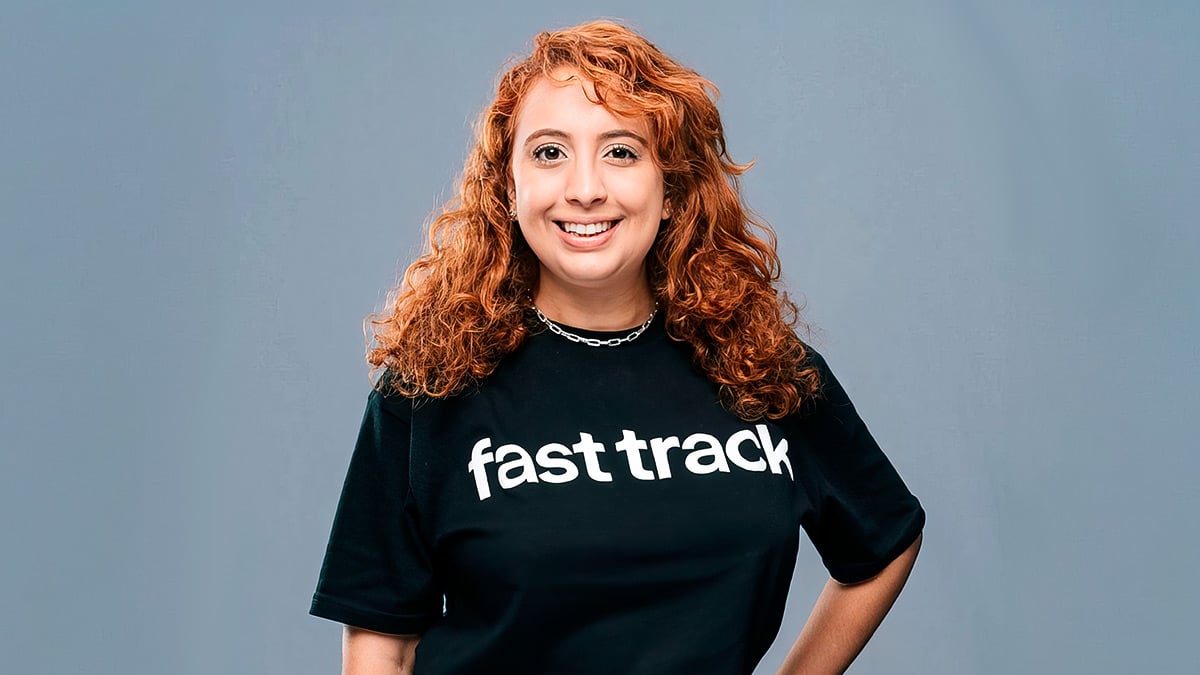
Fast Track was one of the companies participating in BiS SiGMA South America 2026, held in early April in São Paulo. During the event, Yogonet interviewed Muriel Le Senechal, the company’s Regional Commercial Manager for Latin America.
In the interview, she highlighted the strategic importance of Brazil for Fast Track, as well as the need for personalization and education in a segment marked by regional differences and rapid evolution.
Another key topic was the use of artificial intelligence, which, according to the executive, is at the core of Fast Track’s operations. The technology allows the company to analyze data in real time, predict player behavior, and automate highly personalized campaigns, increasing team efficiency and helping operators — especially small and medium-sized ones — differentiate themselves in the market.
Fast Track has a global presence, right? What role does Brazil play today in the company’s strategy?
Fast Track is a Swedish company with offices around the world and a strong presence in Europe and Asia. Our headquarters are in Malta, and we also have offices in Barcelona and Sweden. Whenever we decide to enter a new market, we take a very specific look at local particularities.
In Brazil, this was a long process. We started structuring the operation in 2023, when I joined the company as the first Brazilian employee. Since then, we’ve adapted the product so that it truly makes sense for the Brazilian market, avoiding bringing in something misaligned with the local reality.
Today, Brazil is a priority for the company. We’ve built teams with professionals who speak Portuguese and understand the market, ensuring the same quality of service we provide to European clients. In addition, we’re now able to map the Brazilian market more precisely, especially thanks to access to licensing data, which makes it easier to identify which operators we can work with.
Our strategy is focused on long-term partnerships. We’re not in a rush to close contracts without ensuring a strong integration and experience. We do everything very carefully and want to grow alongside operators in a structured way.
Currently, we have more than 20 clients in Brazil. With regulation, the number of operators has dropped to around 80 licensed companies. That changes the focus: rather than quantity of clients, we analyze the size and quality of those operations.
You’re also responsible for other Latin American markets. Are there major differences between countries in the iGaming sector?
The differences are enormous. I think it’s unfortunate when brands treat Latin America as a single block — and even Brazil itself can’t be seen as homogeneous, since there’s huge regionalization within the country. What works in Southern Brazil may not work in the North, and this becomes even more pronounced when we look at other countries.
Today, we’re present in markets such as Argentina, Colombia, Chile, Peru, Ecuador, Guatemala, and Mexico. For each of them, we develop specific strategies. We always work with professionals who deeply understand the local context to ensure the right approach.
Our goal is to deliver personalization both for the end player and the B2B client, adapting relationships and solutions to clients across Latin America.
In March, you held the Fast Track Spark workshop in São Paulo. How was that experience?
When we started operating in Brazil, we realized the biggest challenge wasn’t selling the platform, but making sure clients used the full potential of the tool.
The Brazilian market grew very quickly, but with lean teams. In many cases, the same person handled acquisition, retention, and social media, which limits the use of more robust CRM tools.
So we created a project from scratch, bringing best practices from more mature international markets to Brazil. It was a two-day immersion with practical content, taking participants from the basics to advanced CRM strategies.
The event brought together around 160 people and received a very positive response. At the end, we applied a test to validate the learning, and participants who scored at least 80% received certification.
We need to bring as much education and content as possible to the Brazilian market to elevate the way the industry positions itself. In five years, iGaming in Brazil achieved something that took England, for example, 20 years — but without the structure and professionalization that were necessary.
How does Fast Track use artificial intelligence?
Artificial intelligence has been the foundation of everything we do for many years. Today, we’re a CRM platform operating with 100% of data processed in absolute real time, with more than 2,500 data points. All of that data is handled through AI and machine learning.
Since 2021, we’ve had the Singularity Model, which understands player behavior and predicts, for example, the best time to send a campaign, the most effective channel, or the most relevant type of offer for each user.
Now, what’s really new within Fast Track is the natural language functionality we launched in 2025. We have our own AI tool powered by prompts. It’s possible to create entire campaigns and reports through prompts directly inside the CRM.
In seconds, our tool can suggest a complete campaign: creating the copy, the email template, the SMS template, and the entire delivery cadence structure. It’s basically a finished campaign for you to review and tweak slightly, which is always necessary with AI.
What might previously have taken a week can now be done in minutes. And this isn’t about replacing human work or eliminating jobs, but about creating more efficiency for teams that currently work very manually and don’t have enough time to think strategically and creatively.
If we look at most websites, emails, and campaigns in Brazil today, it’s hard to tell the difference because many are using the same strategy. If that continues, brands will disappear, and only the large global brands with massive acquisition budgets will remain.
I believe small and medium-sized operators in Brazil need this support to truly differentiate themselves and personalize their communication in order to remain competitive in the coming years.
To close the interview, feel free to add anything that wasn’t asked.
The most important thing to understand about Fast Track is that we are a single company, a single tool, a single integration, and a single environment, with absolutely everything an operator needs for retention, reactivation, and player management.
We have a very strong real-time CRM powered by artificial intelligence, with an enormous range of segmentation and trigger capabilities, as well as bonus abuse prevention tools integrated into all of that data intelligence.
We also have a gamification tool developed entirely in-house and fully open to customization, so each brand can have its own identity in the way it communicates with players, in segmentation, and in how it uses gamification — always with artificial intelligence behind everything.
